
Ask any driving examiner where learners lose marks on the theory test and the answer comes back the same: road signs. Not because they’re difficult, but because there are hundreds of them and most learners try to memorise the lot as flashcards rather than learning the system behind them.
The good news is that UK road signs follow strict rules of shape and colour. Once you know the rules, you can work out the meaning of a sign you’ve never seen before — which is exactly what the DVSA is testing.
There are five families of UK road sign:
- Signs giving orders — things you must or must not do
- Warning signs — hazards ahead
- Direction signs — where roads lead
- Information signs — facilities and features
- Roadworks signs — temporary hazards and diversions
This guide covers the first two in depth, because they generate the overwhelming majority of theory test questions.
Signs giving orders: circles mean compulsion
The single most useful rule in the whole system:
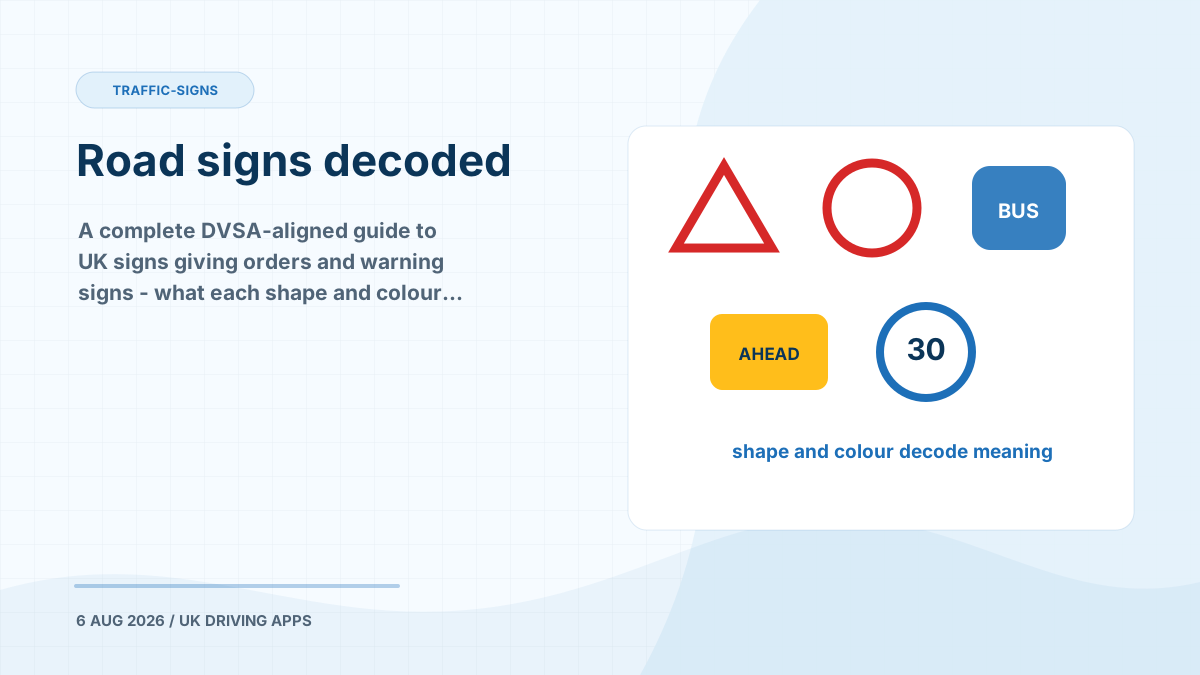
Remember: If a sign is a circle, it’s giving an order. Red circle = prohibition (what you must not do). Blue circle with no red border = positive instruction (what you must do). Triangles warn, rectangles inform.
The bicycle sign is the perfect demonstration. A red circle with a bicycle inside means no cycling. A blue circle with the same bicycle inside means route to be used by pedal cycles only. Same picture, opposite meaning — decided entirely by the colour of the circle.
Red circles: what you must not do
| Sign | Meaning |
|---|---|
| Red circle, white bar | No entry |
| Number in red circle (e.g. 30) | Maximum speed limit in mph |
| Red ring, black car and motorcycle | No motor vehicles |
| Red ring, empty | No vehicles (except bicycles being pushed) |
| Red ring with bus | No buses |
| Two cars, one red | No overtaking |
| Car towing caravan | No towed caravans |
| Red ring with arrow | No right turn / no left turn |
| U-shaped arrow in red ring | No U-turns |
| Height, width or length figure | No vehicles over the dimension shown |
| Weight figure in red ring | No goods vehicles / no vehicles over maximum gross weight shown |
| Explosives symbol | No vehicles carrying explosives |
A few of these catch learners out. The 20 mph zone entry sign and the end of 20 mph zone sign look similar at a glance — the end sign carries a diagonal band across it. And the national speed limit applies sign, a white circle with one black diagonal, doesn’t tell you a number at all: you have to know that it means 60 mph on a single carriageway and 70 mph on a dual carriageway or motorway.
Blue circles: what you must do
Blue circles are the positive half of the family:
- Ahead only, turn left ahead, turn left — the arrow tells you the only permitted direction
- Keep left (or right) — pass the obstruction on the side shown
- Vehicles may pass either side — two arrows, and you may choose
- Mini-roundabout — give way to traffic from your immediate right
- Route for pedal cycles only and segregated cycle and pedestrian route
- Minimum speed and end of minimum speed (the end sign has a diagonal band)
- Buses and cycles only, trams only, one-way traffic
Lane and contraflow signs are usually rectangular blue plates rather than circles: with-flow bus and cycle lane, contraflow bus lane and with-flow cycle lane all appear regularly in DVSA questions.
The special shapes
Two order signs deliberately break the circle rule so you can recognise them at a distance, in fog, or when the face is covered in snow:
- The STOP sign is an octagon — the only octagonal sign on UK roads. You must stop completely at the line, every time, even if the road is empty.
- The GIVE WAY sign is an inverted (downward-pointing) triangle — the only triangle that points down. You must yield, but you needn’t stop if the road is clear.
You’ll also meet the school crossing patrol sign and the manually operated STOP and GO boards used by traffic controllers at roadworks. When someone is holding one of these, their instruction overrides the permanent signs and markings.
Did you know? Waiting and parking restrictions are shown on blue and red rectangular plates, not circles — no waiting, no stopping (clearway), no stopping during the times shown, permit holders only and red route controls. Learners routinely confuse “no waiting” (you may drop off, but not sit there) with “no stopping” (you may not stop at all). Our Road Signs 101 beginner’s guide walks through the distinction in more detail.
Warning signs: red-bordered triangles
Every warning sign in the UK is a white triangle with a red border, and the symbol inside tells you what the hazard is. They are advisory rather than compulsory — nothing about a triangle is an order — but ignoring one is exactly the sort of thing that fails a practical test.
Warning signs group naturally by hazard type:
Junctions and road layout
- Crossroads, T-junction with priority, staggered junction, junction on a bend
- Roundabout ahead, traffic merging from the left or right
- Road narrows on one side or on both sides
- Dual carriageway ends
- Two-way traffic ahead, and two-way traffic crossing a one-way road
- Distance to STOP line ahead (e.g. 100 yards) and distance to GIVE WAY line ahead (e.g. 50 yards)
Road surface and gradient
- Uneven road, humps for the distance shown, hump bridge
- Steep hill downwards and steep hill upwards (the gradient is shown as a percentage or ratio)
- Slippery road, risk of ice, soft verges
- Ford (a worded plate), quayside or river bank, risk of grounding
Bends and restricted space
- Bend to the right or left, double bend (first one direction, then the other)
- Sharp deviation of route — the chevron board on a tight bend
- Tunnel ahead, available width and headroom, overhead electric cables
- Side winds
Vulnerable road users and crossings
- Pedestrians in road ahead, zebra crossing, frail (or disabled) pedestrians crossing
- School crossing patrol ahead, cycle route ahead
- Cattle, wild animals, wild horses or ponies, accompanied horses
- Level crossing with barrier or gate, level crossing without barrier, miniature warning lights at level crossings
- Trams crossing ahead, pedestrian crossing over a tramway
- Swing bridge, low-flying aircraft, falling or fallen rocks
Signals and traffic
- Traffic signals ahead, and traffic signals not in use — treat the junction as uncontrolled and proceed with real caution
- Queues likely ahead
- Other danger — an exclamation mark, always accompanied by a plate telling you what the danger actually is
Tip: Two triangles trip learners up more than any others. Road narrows on the right and road narrows on both sides look nearly identical, and traffic merging from the left is easily mixed up with the slip-road plates. Practise these side by side rather than one at a time — comparison is what fixes them.
How to actually learn them
Memorising 300 pictures is miserable and it doesn’t survive test-day nerves. Do this instead:
- Learn the system first. Circle = order, triangle = warning, rectangle = information. Red = prohibition or hazard, blue = instruction or information, green = primary route, brown = tourist.
- Sort by category, not alphabetically. Study all the level crossing signs together, all the cycle signs together, all the weight and dimension limits together.
- Test yourself on the ones you nearly know. The signs you get right instantly need no more work. Give every minute to the near-misses.
- Read the explanation even when you’re right. The DVSA rewords questions; understanding the reason means the rewording doesn’t matter.
- Look for signs when you’re a passenger. Naming them out loud on a normal car journey is worth more than an hour of revision.
If you want a broader tour of the shape-and-colour logic, our guide to the signing system that helps you decode every sign covers it in full, and the 60 signs you must know for the theory test is a good self-check once you’ve done a first pass.
Practise every sign in one place
The fastest way to get sign-perfect before your test is to work through them in a structured order with a quiz that keeps score.
UK Traffic Signs is built for exactly that. Every road sign explained — browse 980+ UK traffic signs grouped by category, with diagrams, descriptions and a full practice quiz drawn from the DVSA bank. Signs giving orders and warning signs are separate categories, so you can drill the two families covered in this guide until they’re automatic.
Once signs are solid, move on to the rest of the syllabus. The Driving Theory Test app carries 758 official DVSA questions across 15 topics plus the full Highway Code, and the Motorcycle Theory Test app covers 707 official questions for riders. Across all eight apps on drivingapps.co.uk you get 5,200+ questions covering car, motorcycle, LGV, PCV, ADI, the traffic signs reference and the MOT tester annual assessment.
You can also try a free quiz here on the site — no sign-up, no download. Learn the shapes, learn the colours, and the signs stop being something you memorise and start being something you simply read. Good luck on test day.
Frequently asked questions
What are the five types of UK road sign?
What is the difference between a red circle and a blue circle road sign?
What shape is a UK warning sign?
How many road signs are on the UK theory test?
What does a sign with a black diagonal line through it mean?
Related apps
Try a free practice quiz
Reading is great. Practising is better. No sign-up required.