MOT Testers
MOT Tester Annual Assessment
Practice for the DVSA MOT tester annual assessment, plus the Level 2 and Level 3 MOT qualifications. 608 questions written from the MOT inspection manuals, the MOT testing guide and the annual training topics, for Group A and Group B testers, new testers and test centre managers, with every answer referenced to its source.


MOT Tester now has its own site. More free practice questions, topic guides and articles at mottesterexam.co.uk.
Visit mottesterexam.co.ukWhat the app does
Everything below is in the current iPhone and iPad version.
Built for the annual assessment
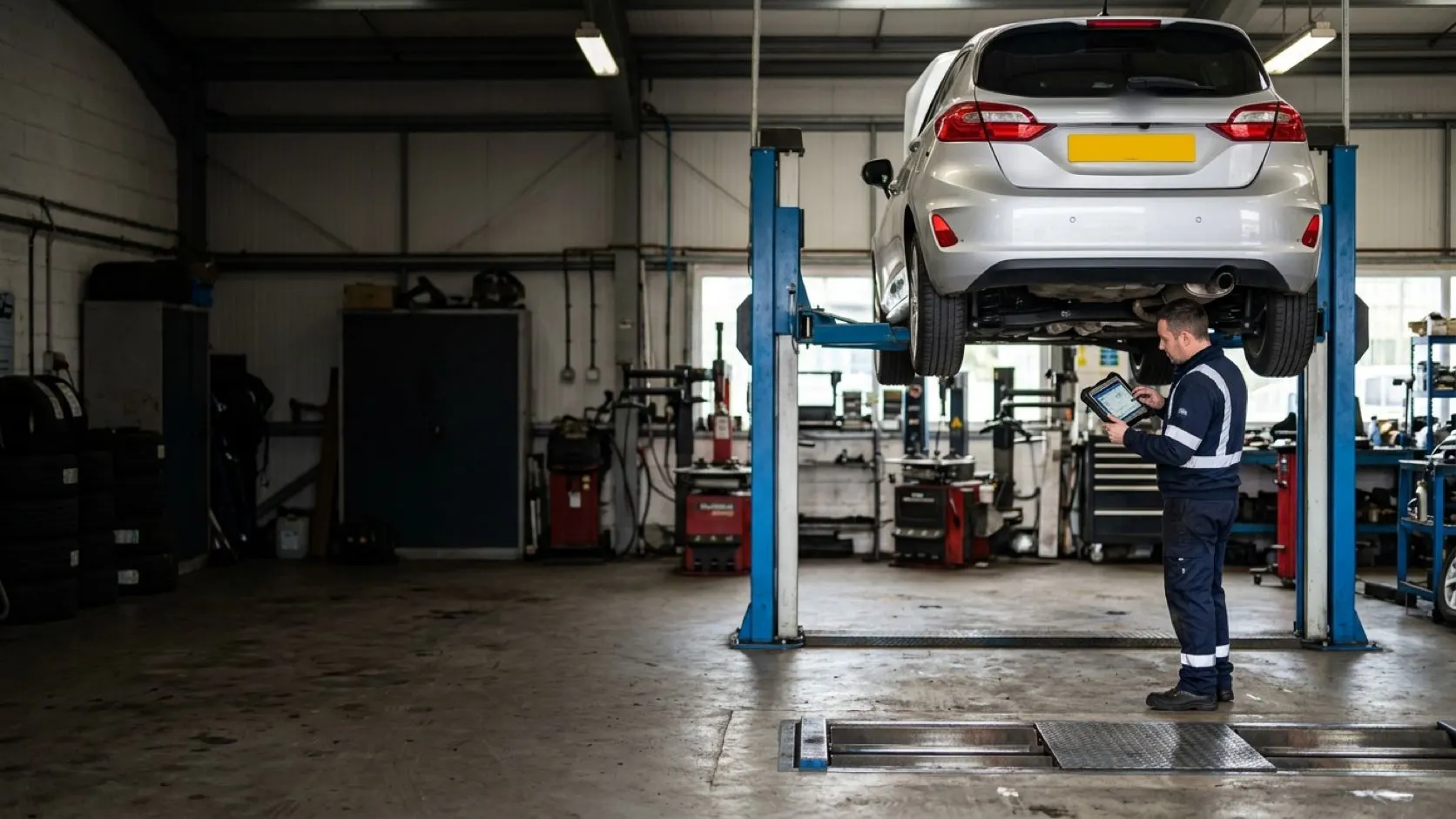
Every authorised MOT tester has to pass DVSA’s annual assessment by the end of the training year to keep testing: 30 multiple-choice questions, 80% to pass. This app is practice for it.
The real paper, not an approximation
The mock test mirrors the DVSA structure: 30 questions drawn in the published proportions — 4 on lamps, reflectors and electrical equipment, 5 on the MOT testing guide, 5 on braking requirements, 12 on the inspection manual for your group and 4 on topics from previous training years — marked against the same 80% pass mark.
Group A and Group B
Choose your route on first launch and switch any time from Settings: Group A for motorcycles and sidecars (classes 1 and 2), Group B for cars and passenger vehicles (classes 3, 4, 5 and 7). Progress is stored separately for each route, so a dual-class tester can work one without losing the other.
Level 2 and Level 3
Two more routes for the MOT qualifications: Level 2 for technicians becoming testers, with a 40-question mock, and Level 3 for test centre managers, with a 35-question mock. They add units the annual assessment does not cover, such as safe working practices, pre-test checks, legislation and compliance, and quality systems and audits.
Referenced to the manual
Questions are written from DVSA’s published material — the MOT inspection manuals, the MOT testing guide, the annual training topics and current special notices. Every explanation ends with the manual section it came from, so you can check it yourself.
Where the two standards differ
Written to catch the places the motorcycle and car papers diverge: pads worn below 1.0 mm on a motorcycle against 1.5 mm on a car, the fixed 27.5% efficiency floor, stop lamps that must work from both brake controls, and the Q-plate rules. Exactly the questions a dual-class tester gets wrong.
These are practice questions written to DVSA’s published topics. They are not the real assessment questions, which DVSA does not publish.
Revise your way
Practice by topic
608 questions in all: 209 for each annual assessment group, 269 on the Level 2 route and 140 on the Level 3 route, which share some topics. Sessions of up to 30 questions, with an explanation on every answer.
Flash cards and history
Flash cards for quick revision, progress tracked per topic and per group, and a mock test history that shows whether you are improving.
Works in the workshop
The whole bank is on your phone, so it works fully offline — no signal needed in the test bay. Progress syncs over iCloud between your iPhone and iPad.
Free and full
The free version gives you a sample of questions in every topic plus a mock test, so you can judge the standard before paying. A subscription or a one-off lifetime unlock opens the full bank on every route.
Try free quizzes
17 topics, 166 free questions. No sign-up.
Group B — cars and passenger vehicles (classes 3, 4, 5 and 7)
Lamps, Reflectors & Electrical Group B
Headlamps and their aim, position and stop lamps, indicators, fog lamps, tell-tales and wiring — and how the manual categorises each defect.
MOT Testing Guide Group B
Tester requirements, VT20 and VT30 documentation, abandoned tests, discipline and the convictions that affect your good repute.
Braking Requirements Group B
Brake condition and performance, efficiency requirements, pads and discs, and the defects each finding carries.
Inspection Manual — Cars Group B
The class 3, 4, 5 and 7 inspection manual: vehicle identification, steering, glazing, tyres, suspension, fuel system, towing equipment and more.
Previous Training Years Group B
Topics from earlier training years: refusing a test, first-used dates, electric and hybrid vehicles, vehicles of historical interest, retests and corrosion.
Group A — motorcycles and sidecars (classes 1 and 2)
Lamps, Reflectors & Electrical Group A
Headlamps and their aim, position and stop lamps, indicators, fog lamps, tell-tales and wiring — and how the manual categorises each defect.
MOT Testing Guide Group A
Tester requirements, VT20 and VT30 documentation, abandoned tests, discipline and the convictions that affect your good repute.
Braking Requirements Group A
Brake condition and performance, efficiency requirements, pads and discs, and the defects each finding carries.
Inspection Manual — Motorcycles Group A
The class 1 and 2 inspection manual: handlebars, forks and steering, wheels and tyres, transmission, exhaust, controls and the horn.
Previous Training Years Group A
Topics from earlier training years: refusing a test, first-used dates, electric and hybrid vehicles, vehicles of historical interest, retests and corrosion.
Level 2 — the MOT testing qualification for new testers
Safe Working Practices Level 2
Level 2: working safely in the test bay — hazards, equipment, protective kit and your health and safety duties.
Customers & Working Relationships Level 2
Level 2: dealing with customers and colleagues, explaining results and handling problems professionally.
Your Professional Development Level 2
Level 2: keeping your knowledge current — annual training, the assessment and recording what you have done.
Pre-Test Checks Level 2
Level 2: what to check before a test starts, and when a vehicle should be refused.
Level 3 — the MOT test centre management qualification
Legislation & Compliance Level 3
Level 3: the legislation and DVSA requirements a test centre must meet, and what happens when it does not.
Roles & Supervising Staff Level 3
Level 3: who is responsible for what in a test centre, and supervising the testers who work there.
Quality Systems & Audits Level 3
Level 3: quality control checks, audits and the records that show a test centre is testing to standard.
Ready for the full bank?
Unlock all 608 questions on every route, full-length mock assessments and flash cards in the app. Available for iPhone, iPad & Android.
More apps for professionals

LGV & HGV Theory Test & Toolkit
Pass your lorry theory test, then keep it in the cab
Pass the LGV / HGV theory test and run your working week. 1,068 DVSA questions across 15 topics, 46 hazard perception clips, the complete Highway Code, 35 Driver CPC Module 2 case studies with a timed mock, and seven Driver Tools — walkaround checks, drivers’ hours, CPC hours, a document wallet, load securing, incidents and a roadside pack.
PCV Theory Test & Toolkit
Pass your bus & coach theory test
Pass the PCV bus and coach theory test and keep the paperwork of the job. 804 DVSA questions across 15 topics, 46 hazard perception clips, the complete Highway Code, 28 Driver CPC Module 2 case studies with a timed mock, and seven Driver Tools — including GB domestic PSV drivers’ hours and a duty log.
ADI / PDI Test & Toolkit
Qualify and run your driving school
The professional ADI / PDI toolkit. Practise Part 1 theory across all four bands, sharpen your Hazard Perception, and run your driving school with built-in tools for pupil tracking, CPD logging, lesson diaries and test routes.