
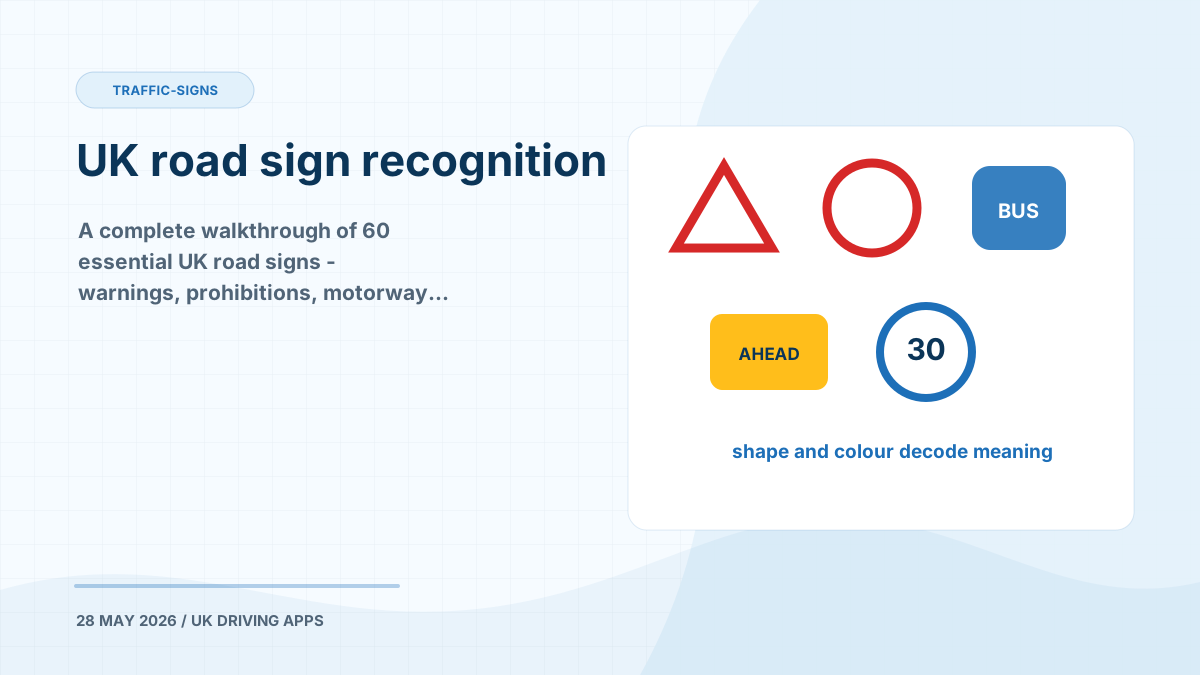
If there’s one topic that shows up on every single UK theory test, it’s road signs. The DVSA loves them — they’re quick to test, impossible to fake, and they reveal whether you’ve actually opened the Highway Code. The good news is that once you understand the signing system (shapes, colours and borders all mean something), even an unfamiliar sign becomes readable.
This guide walks you through 60 of the most common signs you’ll meet on the road — and on your test. They’re grouped the same way the DVSA groups them: warnings, orders, information and direction signs.
The signing system in 30 seconds
Before the list, here’s the rule that unlocks the lot:
| Shape | Purpose | Example |
|---|---|---|
| Triangle (red border, point up) | Warning of a hazard | Bend ahead, children crossing |
| Circle (red border/ring) | Prohibition — must NOT do | No entry, no overtaking |
| Circle (blue, no border) | Mandatory — MUST do | Turn left, mini roundabout |
| Rectangle (blue) | Information on motorways/dual carriageways | Motorway junction |
| Rectangle (green) | Information on primary routes | — |
| Octagon (red) | STOP — the only octagonal sign in use | Stop at the line |
| Inverted triangle (red border) | Give way | Give way at junction |
If you remember nothing else from this guide, remember the table above. For a deeper dive into the logic, our companion post on UK road signs: the signing system breaks it down sign by sign.
Order signs (the ones you MUST obey)
These are the signs that will fail your practical test if you miss them — and they appear constantly in the theory bank too.
- Stop — the only octagonal sign. You must come to a complete halt at the line, even if the road is empty.
- Give way — inverted triangle. Slow, look, and yield to traffic on the major road.
- No entry — red circle with white horizontal bar. Often marks one-way streets.
- No overtaking
- No U-turn
- No right turn
- No left turn
- No stopping (the “Clearway” — red cross on blue)
- No waiting (single red diagonal on blue)
- Pedestrians prohibited
- Buses prohibited
- Motorcycles prohibited
- Horse-drawn vehicles prohibited
- National speed limit applies (white circle, black diagonal)
- 20 mph limit — increasingly common in built-up areas and outside schools.
Tip: A red ring around a circular sign always means a prohibition. A red circle with a slash means “not allowed”. Memorise that pair and you’ve cracked half the order signs in the Highway Code.
Warning signs (triangular, red border)
Triangles tell you what’s coming. The DVSA will often show you the silhouette inside and ask what it warns of.
- Traffic signals ahead — useful where signals are hidden by a bend.
- Roundabout ahead
- Crossroads
- T-junction
- Staggered junction
- Side road ahead
- Traffic merges from left
- Bend to the right (and bend to the left)
- Double bend — first bend direction matters; the sign mirrors the road.
- Road narrows on both sides (and narrows on one side)
- End of dual carriageway — one of the most missed signs on test day.
- Two-way traffic — warns you the road ahead carries traffic in both directions, often after a one-way section.
- Slippery road
- Steep descent (downhill arrow with a percentage)
- Steep ascent
- Uneven road
- Hump bridge
- Pedestrians in road ahead
- Children crossing — typically near schools.
- Cattle crossing
- Sheep crossing
- Falling or fallen rocks
- Queues likely
- Risk of ice
- Side winds
- Road works
- Tunnel ahead — remember to switch on dipped headlights and remove sunglasses.
Information and direction signs
Blue rectangles, green rectangles and the white-on-blue motorway family all sit in this group.
- One-way traffic (rectangular, blue, white arrow)
- Bus lane ahead
- Pedal cyclists only route
- Parking place (“P” on blue)
- No waiting (information variant on regulated streets)
- Controlled parking zone entry
- Contraflow bus lane
- Motorway junction ahead
- End of motorway
- Entrance to motorway
- Exit from motorway
- Countdown markers — three bars (300 yards), two bars (200), one bar (100) to the exit slip.
- Speed camera ahead
- Loose chippings
Road markings that act like signs
Two more you’ll be tested on, even though they’re painted not posted:
- Mini roundabout — blue circle with three curved arrows.
- Keep left bollard — a blue circle with a white arrow, usually on a traffic island.
- Pass either side — two arrows on a blue circle, telling you the obstruction can be passed on either side.
How to actually learn 680 signs
The full DVSA sign bank is huge, but you don’t need to brute-force it. A pattern-based approach works far better:
- Learn the shape/colour rules first (see the table above).
- Group similar signs together — all the prohibitions, all the warnings, all the motorway signs.
- Quiz yourself on silhouettes, not just full-colour images. The DVSA loves to strip context.
- Revisit weak categories daily rather than re-quizzing the ones you already know.
Did you know? Signs and signals are the single largest topic in the DVSA multiple-choice bank. Investing one full evening on signs alone can be worth 5–8 marks on test day — often the difference between a pass and a re-book.
If you want a structured plan around signs, our pass-first-time guide shows where signs fit into a four-week revision schedule, and UK Road Signs Explained goes deeper into shapes and colours.
Practise every UK road sign on your phone
Sign recognition is the perfect topic for daily phone practice — short bursts, instant feedback, no need to sit at a desk.
Our UK Traffic Signs app covers 980+ UK traffic signs grouped by category, with diagrams, plain-English descriptions and a full practice quiz drawn from the DVSA bank. Whether you’re a learner car driver, a CBT-day motorcyclist, or a professional studying for your LGV or PCV, sign recognition is non-negotiable — and this is the fastest way to drill it.
The traffic signs app sits alongside the rest of the drivingapps.co.uk suite: 8 specialist UK driving apps with 5,200+ questions between them, covering car, motorcycle, LGV, PCV, the ADI/PDI toolkit and the MOT tester annual assessment. Pick the app that matches your test, drill signs daily for a fortnight, and you’ll walk into the test centre knowing every triangle, circle and rectangle the DVSA can throw at you.
Good luck — and remember, every sign tells you something before you’ve even read the words.
Frequently asked questions
How many road signs do I need to know for the UK theory test?
What is the difference between a circular and triangular road sign?
What does a red ring around a sign mean?
Are road sign questions in the hazard perception or multiple-choice section?
Related apps
Try a free practice quiz
Reading is great. Practising is better. No sign-up required.