
Walk into any UK theory test and you’ll find road signs everywhere — in the multiple-choice questions, in the hazard perception clips, and waiting for you the moment you start your practical lessons. The good news is that UK road signs aren’t random. They follow a clear shape-and-colour system, and once you understand it, you can decode signs you’ve never even seen before.
This guide walks you through that system, shows you how to apply it to tricky questions, and explains how to revise the handful of signs that you genuinely do have to memorise.
The shape-and-colour system at a glance
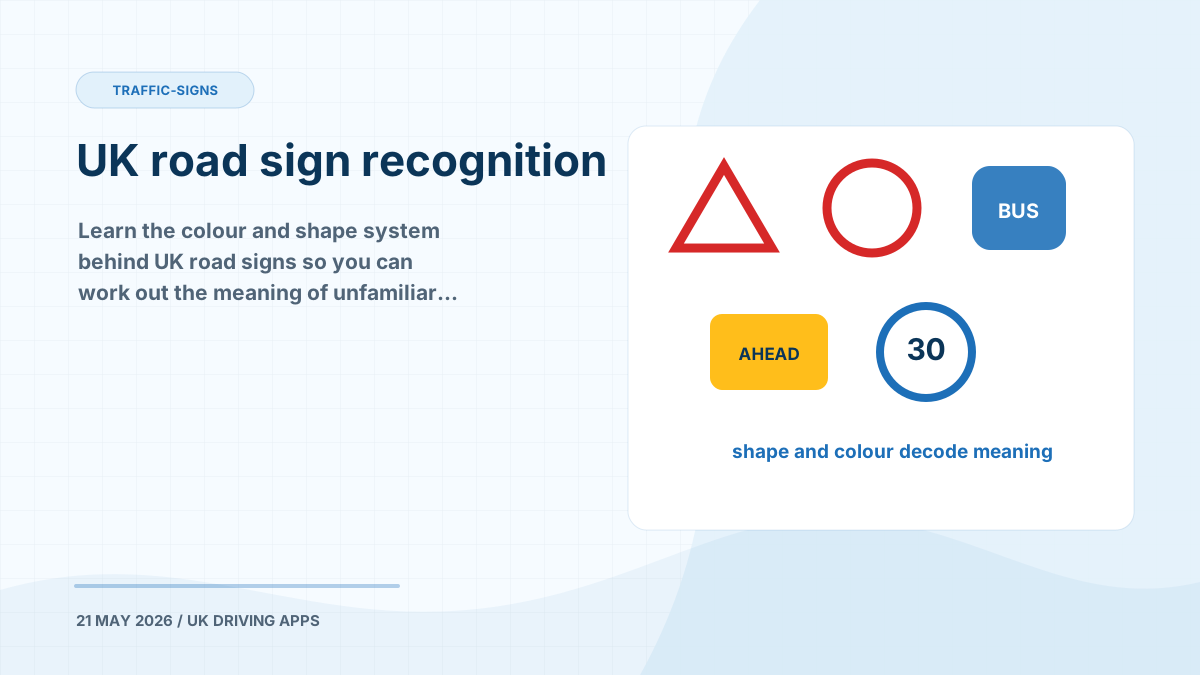
Every sign on a UK road belongs to one of three families. The shape tells you the purpose, and the colour tells you whether it’s a positive instruction, a negative one, or just information.
| Shape | Purpose | Colour clues |
|---|---|---|
| Circle | Gives orders (legally enforceable) | Blue = must do; red border = must not do |
| Triangle | Warns of a hazard ahead | Red border, white background |
| Rectangle | Gives directions or information | Blue (motorway), green (primary route), white (minor), brown (tourist) |
Tip: A useful memory aid borrowed from video games — blue circles are your allies (do this), red circles are your enemies (don’t do this). Triangles are the “watch out!” alarms. Rectangles are the helpful signposts.
If you don’t follow an order given by a circular sign, you risk a Fixed Penalty Notice, points on your licence, or being pulled over by police. Triangles aren’t legally enforceable in themselves, but ignoring the hazard they warn about will almost certainly mean you fail your practical test — or worse.
Decoding signs you’ve never seen before
Here’s the powerful part: even if the exact sign is unfamiliar, the system narrows the answer down to one likely option. Let’s walk through three quick examples using a bicycle symbol.
Example 1 — Bicycle in a red-bordered circle
- Shape: circle → it’s an order.
- Colour: red border → it’s a negative order (something you must not do).
- Symbol: bicycle.
- Meaning: no cycling.
Example 2 — Bicycle in a solid blue circle
- Shape: circle → it’s an order.
- Colour: blue → it’s a positive order (something you must do).
- Symbol: bicycle.
- Meaning: route to be used by pedal cycles only.
Example 3 — Bicycle in a red triangle
- Shape: triangle → it’s a warning.
- Symbol: bicycle.
- Meaning: cycle route ahead — watch out for cyclists who may be crossing or sharing your road.
Three almost identical pictures, three completely different meanings — and you can work each one out from the system alone. If you’ve ever felt overwhelmed by the sheer number of signs in the Highway Code, this is your shortcut.
Signs you genuinely have to memorise
The system gets you a long way, but a handful of signs don’t follow obvious logic and have to be learned by rote. The main culprits are:
- Warning signs with unusual symbols — for example, the sign for a level crossing without a barrier, or the one for a quayside or river bank ahead.
- Older, non-standard signs still in use on rural roads.
- Information signs in rectangles where the symbol alone doesn’t tell you much (such as “no through road” or “with-flow bus lane”).
- Road markings painted on the carriageway itself — these aren’t sign-shaped but they carry the same legal weight.
Did you know? The Highway Code contains well over 600 signs, signals and road markings. The DVSA test only draws from the most commonly used ones, but the UK Traffic Signs app covers 980+ so you’re never caught out.
How road signs show up in the theory test
Signs and signals are the largest single source of questions on the DVSA multiple-choice paper. Expect them to appear in several formats:
- “What does this sign mean?” — a picture of the sign with four written options.
- “Which sign means X?” — a written description with four sign pictures.
- Scenario questions — “You see this sign at a junction. What should you do?”
- Pairings — questions about which sign goes with which road marking.
They also pop up constantly in the hazard perception clips. A “school” warning sign in the opening seconds of a clip is the examiner’s way of telling you to start scanning for children — clicking when one steps out is far too late.
For a deeper walkthrough of test structure and a four-week revision plan, see our guide to passing the UK theory test first time. And if you’re preparing for a professional licence, the same sign knowledge is tested in the LGV vs PCV theory tests — just with more questions overall.
A four-step revision routine for signs
This is the routine that works for most of our app users:
- Read the signs chapter of the Highway Code end to end. Don’t skip the road markings section — it’s the most overlooked.
- Group the signs by shape. Spend a session on circles, a session on triangles, a session on rectangles, then a session on markings.
- Quiz yourself daily for two weeks. Short, frequent sessions beat one long cram.
- Mix in mock tests so you see signs in the same multiple-choice format as the real exam.
Remember: It’s not enough to recognise a sign — you must also know what action to take when you see one. “Steep hill downwards” isn’t useful knowledge unless you also remember to select a lower gear before you start descending.
Beyond the test: signs in real driving
Sign knowledge doesn’t stop mattering the day you pass. New signs appear regularly — smart motorway gantries, low-emission zones, school streets, low-traffic neighbourhoods — and if you don’t recognise them, you can pick up fines without ever realising you’ve broken a rule. Keeping the shape-and-colour system in your head means you can read a new sign correctly the first time you meet it.
If you’re considering teaching others to drive, sign recognition is a core part of the ADI Part 1 syllabus too — our becoming a driving instructor guide walks through how the standard rises for the professional test.
Practise UK road signs with our apps
The fastest way to lock in the signing system is to test yourself on real DVSA-style questions until the answers become automatic.
- UK Traffic Signs — every road sign explained. Browse 980+ UK traffic signs grouped by category, with diagrams, descriptions and a full practice quiz drawn from the DVSA bank. This is the app to use if you want to drill signs specifically.
The Traffic Signs app sits alongside our wider suite of UK theory test apps — covering car, motorcycle, LGV, PCV and the ADI professional toolkit — giving you 5,200+ questions across 8 apps in total. Whichever test you’re preparing for, mastering signs first will give every other topic a head start.
Good luck — and next time you spot an unfamiliar sign on the road, remember: shape first, colour second, symbol third. The system will do the rest.
Frequently asked questions
What do circular road signs mean in the UK?
What do triangular road signs mean?
What do rectangular road signs mean?
How many road sign questions are on the UK theory test?
Do I need to memorise every road sign for the theory test?
Related apps

Try a free practice quiz
Reading is great. Practising is better. No sign-up required.