
Ask any driving instructor which theory test category trips up the most learners and you’ll get the same answer: road and traffic signs. It’s the biggest single topic in the DVSA question bank, and it’s where most failed tests lose their marks.
Here’s the good news — you don’t need to memorise hundreds of signs one by one. The UK signing system is built on a small set of shapes and colours, and once you understand the logic, you can decode signs you’ve never even seen before. This guide walks you through that system, the signs that come up again and again on the theory test, and the sneaky question wordings the DVSA loves.
The golden rule: shape tells you the job
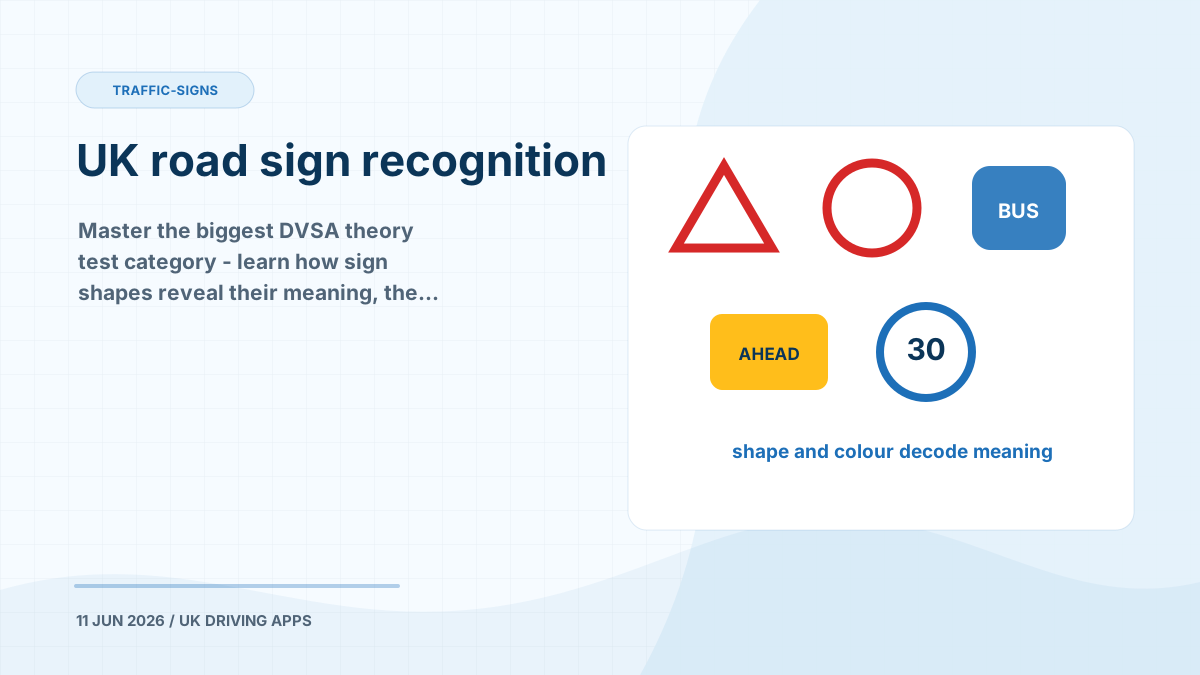
Before you learn a single sign, learn the shapes. Every UK road sign falls into one of these families:
| Shape | Meaning | Example |
|---|---|---|
| Red circle | Prohibition — what you must NOT do | No entry, no overtaking, speed limits |
| Blue circle | Mandatory instruction — what you MUST do | Mini-roundabout, turn left, minimum speed |
| Red triangle | Warning — hazard ahead | Roadworks, crossroads, ford |
| Rectangle | Information or directions | One-way street, motorway signs |
| Octagon | STOP — unique shape | The only octagonal sign in the Highway Code |
| Inverted triangle | GIVE WAY — unique shape | The only upside-down triangle |
Did you know? STOP and GIVE WAY are the only signs with their shapes in the entire Highway Code. That’s deliberate — when a sign is caked in snow or ice, you can still identify it by its outline alone. The DVSA asks about exactly this.
For a deeper dive into the full system, see our guide to UK road signs explained: shapes, colours and what they mean.
Red circles: 95% of them mean “no”
Here’s a tip that gets learners out of trouble on test day: the vast majority of red circle signs are prohibitions. If you see a red circle and don’t recognise the symbol inside, look at your four answer options — the correct one almost certainly starts with “no”.
The red circles that appear most often on the theory test:
- No motor vehicles — a car and motorcycle together. Learners constantly confuse this with no overtaking, which shows two cars side by side.
- No entry — the solid red circle with a white horizontal bar. Red means danger; do not pass.
- No waiting — a single diagonal slash. You may stop briefly to drop off or pick up a passenger, but you can’t park. This matches a single yellow line.
- No stopping (clearway) — the red X. No stopping at any time, equivalent to double yellow or double red lines.
- End of 20 zone — a 20 with a line through it next to a 30 limit. If the number is crossed out, the restriction is ending.
Tip: Speed limits follow the circle rule too. A red circle with 30 inside is a maximum of 30 mph. The same number in a solid blue circle is a minimum speed limit — and crossed out, it marks the end of that minimum.
One more red-circle staple: the national speed limit applies sign is the white circle with a black diagonal stripe. On a dual carriageway or motorway that means 70 mph for cars (60 for lorries); on a single carriageway it’s 60 mph for cars (50 for lorries).
Triangles: warnings of what’s ahead
Red-bordered triangles warn you about a hazard so you can check your mirrors and slow down in good time. The ones the DVSA loves:
- Two-way traffic straight ahead vs two-way traffic crosses a one-way street. These two catch learners out every week. The trick: always read sign diagrams from bottom to top, as if you’re driving up the sign. Vertical arrows mean two-way traffic on your road; horizontal arrows mean two-way traffic crossing your route.
- Dual carriageway ends. The central reservation (the white block in the middle) disappears ahead — usually followed shortly by the two-way traffic sign.
- Crossroads vs T-junction. Again, read bottom to top — the thick line is your road, the thinner lines are the minor roads.
- Level crossing. With a gate pictured, it’s a crossing with gates or barriers; a steam train symbol alone means a crossing without them.
- Steep gradient. We read left to right, so a slope rising left-to-right is a steep hill upwards; falling is downwards.
- Side winds. The windsock sign. High-sided vehicles are affected most; cars least. Exposed stretches, viaducts and bridges are the danger spots.
- Ford. Surface water across the road. Drive through very slowly in a low gear, then test your brakes on the other side — wet brakes don’t bite.
- Roundabout. A triangle with circular arrows warns of a full-size roundabout ahead (the blue circle version means a mini-roundabout). To go straight ahead at a roundabout, signal left only after you pass the exit before the one you want.
- Pedestrian crossings and elderly people crossing. The DVSA may describe the crossing collectively (“pedestrian crossing”) or name a specific type — zebra, pelican, puffin, toucan.
Blue circles: mandatory instructions
Blue circles tell you what you must do. On older test versions the answers said “instruction” or “positive instruction”; recent versions increasingly use the word mandatory — look for any of the three.
Common blue circles:
- Mini-roundabout — three arrows in a circle.
- Minimum speed limit — e.g. 30 in a blue circle; crossed out means the minimum ends.
- Pass either side — to reach the same destination, often around a traffic island.
- Ahead only — a single upward arrow. Don’t confuse it with the blue rectangle showing an arrow, which means one-way street.
- Contraflow vs with-flow bus and cycle lane — contra means against the flow, shown with an opposing arrow; no opposing arrow means with-flow.
Question traps to watch for
The wording of theory test questions is where prepared learners still drop marks. Watch for these patterns:
- “Affected most” vs “affected least.” Side winds affect high-sided vehicles most and cars least — read which way the question flips it.
- “Stop behind the line”, not “beyond the line.” At a STOP sign, both appear as options. Beyond the line means you’ve gone too far.
- Echo words. If the question asks when you may use hazard warning lights, the right answer usually contains the word “hazard” (e.g. warning traffic behind of a hazard ahead on a motorway). It’s not foolproof, but the answer still has to make sense.
- Look at the image first. Take in the picture before reading the question, not after — it frames everything.
- Police signals. A flat palm or the back of a flat hand means stop; an officer at failed traffic lights is acting as a red light. And when no signals or lights are working at a junction, nobody has priority — proceed with care.
- Brown signs are always tourist attractions; never confuse them with warnings.
Remember: if you struggle with reading, or you have dyslexia, you can have every theory test question read aloud through headphones at the test centre. There’s no shame in it — declare it when you book, and give yourself the best chance of passing first time.
Once you’ve got the system down, test yourself against our 60 must-know UK road signs for the theory test, then fold signs revision into the full four-week plan in our guide to passing the UK theory test first time.
Practise every sign before test day
Reading about signs gets you started — recognising them instantly under exam pressure is what passes the test. That’s exactly what the UK Traffic Signs app is built for: every road sign explained, with 980+ UK traffic signs grouped by category, clear diagrams and descriptions, and a full practice quiz drawn from the DVSA bank. Browse the red circles, triangles and blue circles side by side until the shape logic becomes second nature.
It’s part of the drivingapps.co.uk suite — 5,200+ questions across 8 apps covering car, motorcycle, LGV, PCV, ADI and traffic signs — so whichever licence you’re working towards, there’s an official-question-bank app to match. You can also try free quizzes right here on the site, no sign-up needed. Learn the shapes, trust the system, and the biggest category on the theory test becomes your easiest marks.
Frequently asked questions
What do the different road sign shapes mean in the UK?
What does a red circle road sign mean?
Why is the STOP sign octagonal?
What is the biggest category on the UK theory test?
How should I drive through a ford?
Related apps

Try a free practice quiz
Reading is great. Practising is better. No sign-up required.