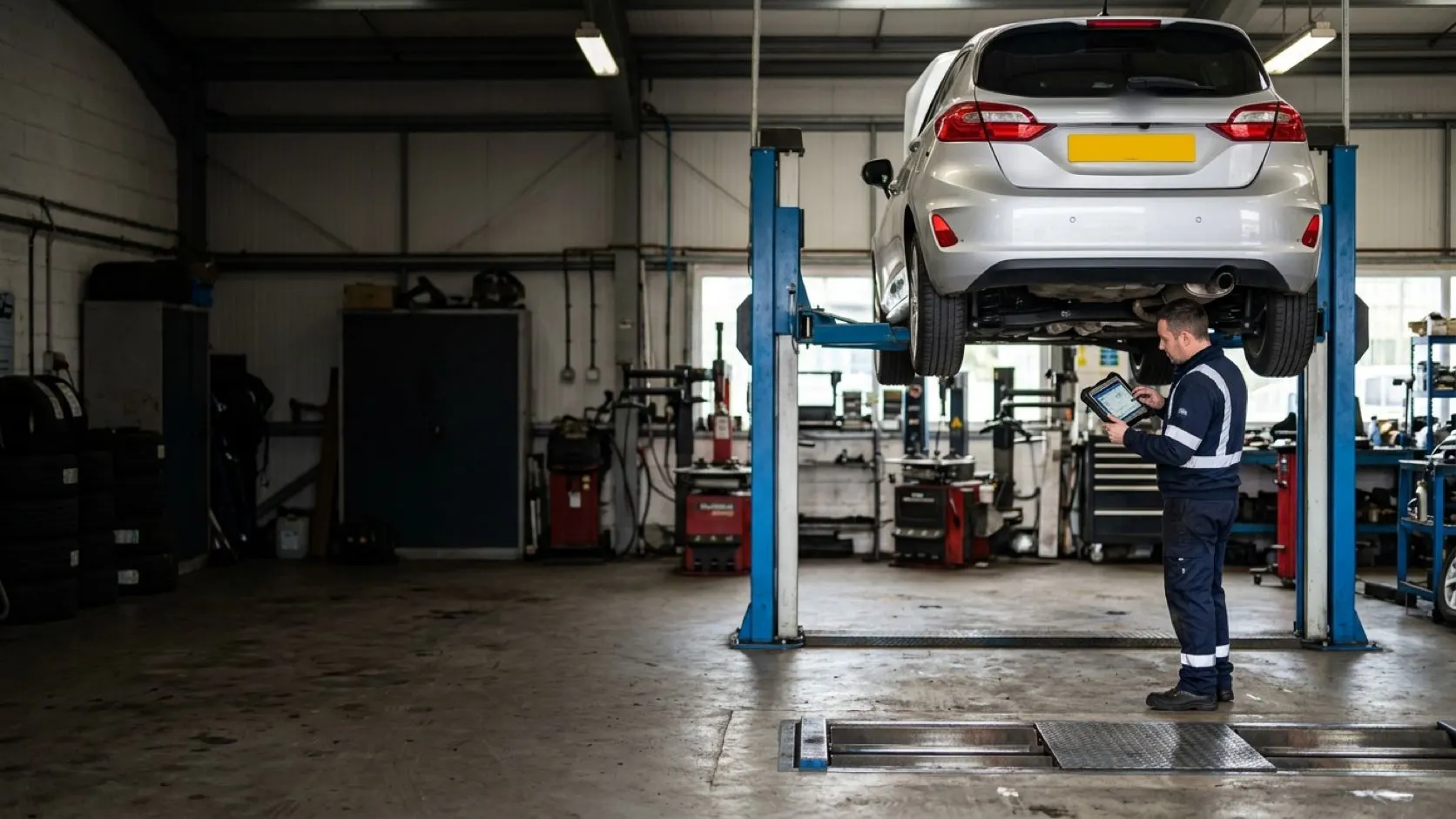
Study guide
MOT Tester Annual Assessment — Study Guide
A topic-by-topic look at what you need to know for the MOT Tester Annual Assessment. Each guide ends with a free quiz.
Group B — cars and passenger vehicles (classes 3, 4, 5 and 7)
Lamps, Reflectors & Electrical
Headlamps and their aim, position and stop lamps, indicators, fog lamps, tell-tales and wiring — and how the manual categorises each defect.
MOT Testing Guide
Tester requirements, VT20 and VT30 documentation, abandoned tests, discipline and the convictions that affect your good repute.
Braking Requirements
Brake condition and performance, efficiency requirements, pads and discs, and the defects each finding carries.
Inspection Manual — Cars
The class 3, 4, 5 and 7 inspection manual: vehicle identification, steering, glazing, tyres, suspension, fuel system, towing equipment and more.
Previous Training Years
Topics from earlier training years: refusing a test, first-used dates, electric and hybrid vehicles, vehicles of historical interest, retests and corrosion.
Group A — motorcycles and sidecars (classes 1 and 2)
Lamps, Reflectors & Electrical
Headlamps and their aim, position and stop lamps, indicators, fog lamps, tell-tales and wiring — and how the manual categorises each defect.
MOT Testing Guide
Tester requirements, VT20 and VT30 documentation, abandoned tests, discipline and the convictions that affect your good repute.
Braking Requirements
Brake condition and performance, efficiency requirements, pads and discs, and the defects each finding carries.
Inspection Manual — Motorcycles
The class 1 and 2 inspection manual: handlebars, forks and steering, wheels and tyres, transmission, exhaust, controls and the horn.
Previous Training Years
Topics from earlier training years: refusing a test, first-used dates, electric and hybrid vehicles, vehicles of historical interest, retests and corrosion.
Level 2 — the MOT testing qualification for new testers
Safe Working Practices
Level 2: working safely in the test bay — hazards, equipment, protective kit and your health and safety duties.
Customers & Working Relationships
Level 2: dealing with customers and colleagues, explaining results and handling problems professionally.
Your Professional Development
Level 2: keeping your knowledge current — annual training, the assessment and recording what you have done.
Pre-Test Checks
Level 2: what to check before a test starts, and when a vehicle should be refused.
Level 3 — the MOT test centre management qualification
Legislation & Compliance
Level 3: the legislation and DVSA requirements a test centre must meet, and what happens when it does not.
Roles & Supervising Staff
Level 3: who is responsible for what in a test centre, and supervising the testers who work there.
Quality Systems & Audits
Level 3: quality control checks, audits and the records that show a test centre is testing to standard.
Unlock all 608 questions on every route, full-length mock assessments and flash cards in the app.