
Some learners spend weeks revising for the UK driving theory test. Others leave it until the last few days and hope for the best. The honest answer sits somewhere in the middle: you can make a lot of progress in four focused hours, but only if you use that time on the areas that actually move your score.
The learner in the transcript passed first time after a short revision window, scoring 46 out of 50 in the multiple-choice section and 59 out of 75 in hazard perception. That is comfortably above both pass marks. The lesson is not that everyone should cram. It is that theory test revision works best when it is targeted, active and based on the DVSA syllabus.
This guide shows you how to use a short revision window sensibly, what to prioritise, and where learners usually lose easy marks.
The theory test format at a glance
For the Category B car theory test, you take two parts in the same appointment:
| Section | What you do | Pass mark |
|---|---|---|
| Multiple choice | Answer 50 questions from the DVSA theory test syllabus | 43 out of 50 |
| Hazard perception | Watch 14 video clips and click for developing hazards | 44 out of 75 |
You must pass both parts at the same sitting. If you pass multiple choice but fail hazard perception, you still have to retake the whole theory test.
Remember: The theory test is not just a memory quiz. It checks whether you can recognise rules, signs, risks and safe decisions before you start driving independently.
At the test centre, you will need your valid photocard provisional driving licence. You will usually be asked to store your phone, watch and other personal items in a locker before going into the test room. The multiple-choice section has a time limit of 57 minutes, but many candidates finish earlier. Do not rush just because you can.
Can you really pass with only 4 hours of revision?
It depends on your starting point. If you already understand basic road behaviour, have seen lots of signs as a passenger, and can stay calm under test conditions, four hours of focused revision may be enough to get you over the line. If you are new to UK roads, struggle with signs, or have failed mock tests badly, you should give yourself more time.
A good short-revision target is not just scraping 43 out of 50. Aim for:
| Practice area | Safe target before test day |
|---|---|
| Multiple-choice mock tests | 46+ out of 50 |
| Hazard perception practice | 55+ out of 75 |
| Road signs | 90%+ correct |
| Stopping distances and safety margins | Confident without guessing |
The closer your mock scores are to the pass mark, the more one difficult question, one misread instruction or one poor hazard clip can cost you.
For a fuller study structure, see our 2026 first-time pass guide. If your test is very soon, the plan below keeps your revision concentrated.
Hour 1 — Learn road signs properly
Road signs are one of the highest-value areas in the theory test because they appear in many forms: sign recognition, road markings, junction behaviour, speed limits, warnings and instructions.
Start with the system behind the signs rather than trying to memorise each one separately.
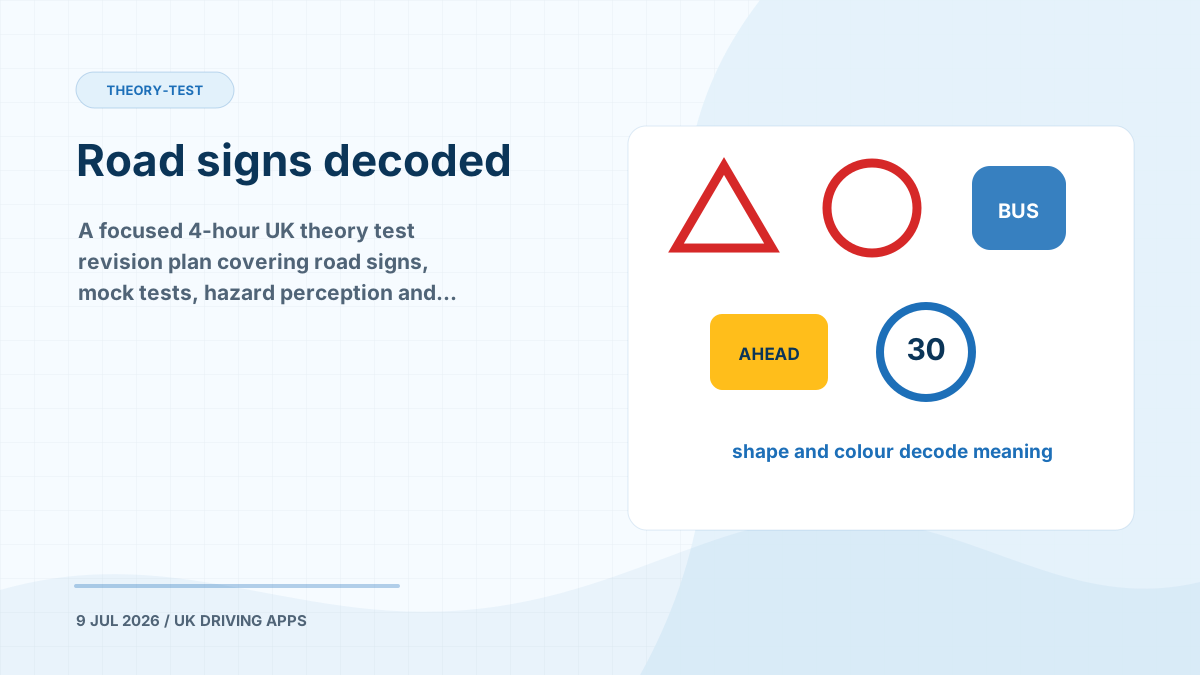
| Sign feature | What it usually means |
|---|---|
| Red circles | Orders or prohibitions, such as no entry or speed limits |
| Blue circles | Positive instructions, such as turn left or minimum speed |
| Red triangles | Warnings, such as bends, junctions or hazards ahead |
| Octagon | Stop |
| Inverted triangle | Give way |
| Rectangular signs | Information, directions or lane guidance |
The transcript makes a useful point: if a stop sign is covered in snow, its octagonal shape still tells you what it means. The same applies to the give way sign, which is the only inverted triangle used on UK roads.
Tip: Learn signs by colour and shape first, then practise individual signs. This makes unfamiliar questions easier because you can often work out the meaning from the sign family.
If signs are your weak point, read our guide to UK road sign shapes, colours and meanings before doing mock tests.
Hour 2 — Cover the facts learners often forget
After signs, spend time on the rules and facts that appear regularly but are easy to mix up. These are not glamorous topics, but they are marks you can win quickly.
Focus on:
- Documents: driving licence, insurance, MOT, vehicle tax and registration details
- Stopping distances: dry, wet and icy conditions
- Following distances: the two-second rule in dry conditions, longer in poor weather
- Tyres: minimum tread depth and tyre condition
- Towing: speed limits, loading and stability
- Motorways: lane discipline, smart motorways, breakdowns and red X signals
- Vulnerable road users: pedestrians, cyclists, motorcyclists, horse riders and children
- Road markings: yellow lines, box junctions, bus lanes and cycle lanes
A few examples are especially worth knowing. In wet weather, stopping distances can be at least double. On ice, they can be ten times greater. The legal minimum tread depth for car tyres is 1.6 mm across the central three-quarters of the breadth of the tyre and around the entire circumference.
Did you know? Many theory test questions are testing judgement, not trivia. If one answer protects vulnerable road users, increases space or reduces speed near a hazard, it is often the safest choice.
For harder examples, use our walkthrough of 25 of the hardest UK theory test questions.
Hour 3 — Do full mock tests, then review your mistakes
Mock tests are where short revision becomes effective. Reading notes is passive. Answering questions forces your brain to retrieve the rule, spot the wording and choose under pressure.
Do one full 50-question mock test under realistic conditions:
- Put your phone away.
- Set a 57-minute limit.
- Do not check notes during the test.
- Flag questions you are unsure about.
- Review every wrong answer afterwards.
The review matters more than the score. If you get 37 out of 50 on your first mock, that is not a disaster. It tells you which topics need attention. Go through each wrong answer and ask:
- Did I misread the question?
- Did I miss “mark two answers” or “mark three answers”?
- Was it a sign, rule, document or safety question?
- Did I guess because I had never revised the topic?
- Would I recognise the same rule if the wording changed?
Then do another mock. Your score should climb as repeated topics start to stick.
Tip: Do not just memorise the letter of the answer. Read the explanation so you understand why the safe answer is correct.
Hour 4 — Practise hazard perception calmly
Hazard perception is where many learners lose confidence. You are not trying to spot every possible risk. You are trying to click when a developing hazard appears: something that causes you, as the driver, to change speed, direction or position.
Examples include:
- A pedestrian moving towards the road
- A car edging out of a side road
- A cyclist swerving around a parked vehicle
- Brake lights ahead with traffic slowing suddenly
- A bus pulling away from a stop
- A child near the kerb who may step into the road
The transcript describes clicking when the hazard first appears, then clicking again as it develops. The principle is useful: do not wait until the hazard is obvious and directly in front of you. However, you must avoid clicking repeatedly in a fixed pattern or clicking too many times, because the test software can mark that clip as zero.
A safer approach is:
- Click when you first see the developing hazard.
- Click again if the situation clearly develops further.
- Keep watching the whole clip, because one clip contains two scoring hazards.
- Avoid rhythmic clicking or guessing.
For a deeper explanation, read our hazard perception test guide.
A realistic 4-hour revision plan
If your test is coming up fast, use this schedule:
| Time | Task | Goal |
|---|---|---|
| 0:00-0:45 | Road sign shapes, colours and meanings | Decode signs quickly |
| 0:45-1:30 | Essential rules and facts | Cover common easy marks |
| 1:30-2:15 | Full multiple-choice mock test | Find weak areas |
| 2:15-2:45 | Review wrong answers | Fix mistakes, not just scores |
| 2:45-3:30 | Second mock test or weak-topic practice | Reach 46+ if possible |
| 3:30-4:00 | Hazard perception clips | Practise timing and calm clicking |
This is a compressed plan. If you have more time, spread it over several days and add more mocks. Cramming can work for some candidates, but consistency is more reliable.
Common mistakes to avoid
Short-revision candidates often fail for avoidable reasons. Watch out for these:
- Ignoring road signs. Signs are too important to leave until the end.
- Doing mocks without reviewing them. Repeating the same mistake ten times is not revision.
- Clicking too much in hazard perception. The test rewards timely recognition, not frantic clicking.
- Rushing the multiple-choice section. You have time, so read the wording carefully.
- Forgetting multiple-answer questions. Some questions ask for more than one answer.
- Stopping at 43 out of 50 in practice. That leaves no margin for nerves or difficult wording.
Remember: A pass is 43 out of 50, but your practice target should be higher. Treat 46+ in mock tests as your safety margin.
Use the right app for focused revision
The fastest way to revise is to practise the same style of questions you will face in the real test, then learn from the explanations. The Driving Theory Test app is built for learner car drivers preparing for the Category B theory test, with 758 official DVSA questions across 15 topics, full mock tests and the entire Highway Code in one place.
For this topic, the most relevant app is:
| Learner goal | Recommended app |
|---|---|
| Pass the Category B car theory test | Driving Theory Test |
Drivingapps.co.uk also offers a wider suite for UK road users and professional drivers, with 5,200+ questions across 8 apps covering car, motorcycle, LGV/HGV lorry, PCV bus and coach, ADI driving instructor preparation, and UK traffic signs.
If your test is soon, prioritise road signs, weak-topic review, full mocks and hazard perception practice. Four hours can make a real difference, but only if every minute is active revision.
Frequently asked questions
Can I pass the UK driving theory test with 4 hours of revision?
What is the pass mark for the UK car theory test?
What should I revise first for the UK theory test?
How should I click in the hazard perception test?
What should I take to the theory test centre?
Related apps

Try a free practice quiz
Reading is great. Practising is better. No sign-up required.