
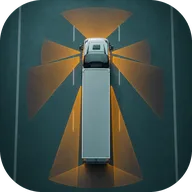
Professional driver trainee reviewing theory preparation beside a parked lorry

LGV study notes

Restricted View

Mirrors, blind spots and how a large vehicle limits what you can see.

What this topic covers

Mirrors, blind spots and how a large vehicle limits what you can see. The full LGV & HGV Theory Test & Toolkit app contains 43 questions on this topic.

In the app's syllabus: Mirrors, Signals, Parking, Moving off, Blind spots, Observation at junctions.

Worked examples

Here are a few practice questions from this topic. Try answering each before reading the explanation.

Example 1

Some lorries have an extra mirror angled down towards the nearside front wheel. What's this mirror especially useful for?

  • A. Overtaking
  • B. Parking ✓ correct
  • C. Checking your trailer
  • D. Turning right
Explanation: Sitting in a high cab does not always give you all-round visibility. Other road users might assume that you can see them and position themselves out of sight close to your vehicle. Making good use of any extra mirrors can help prevent dangerous incidents, especially when parking.
Example 2

What's the first thing you should check before moving to the left?

  • A. The nearside mirror ✓ correct
  • B. The offside mirror
  • C. Behind, over your right shoulder
  • D. Behind, over your left shoulder
Explanation: Before you make a turn or a change of direction, however slight, you should always check the mirrors. If you intend to turn left, check your left-hand (nearside) mirror first.
Example 3

The MSM routine should be used when you negotiate a hazard. What do the initials MSM stand for?

  • A. Mirrors, signal, manoeuvre ✓ correct
  • B. Manoeuvre, speed, mirrors
  • C. Mirrors, speed, manoeuvre
  • D. Manoeuvre, signal, mirrors
Explanation: Always use the MSM routine when you’re approaching a hazard. M – Mirrors: check the position of the traffic behind you. S – Signal: signal your intention to slow down or change course in good time. M – Manoeuvre: a manoeuvre is any change in position, from slowing or stopping the vehicle to turning off a busy road.
Example 4

When may an audible warning device for reversing be used in areas with a 30 mph speed limit?

  • A. Between 7am and 11:30pm ✓ correct
  • B. Between 11:30pm and 7am
  • C. During daylight hours only
  • D. At any time of the day or night
Explanation: Some vehicles are fitted with an audible warning device that sounds when the vehicle is being reversed. As these devices make a loud noise, they should not be used between 11:30pm and 7am in a built-up area. Audible warning devices are an effective safety feature, but they do not take away the need to use effective observation around the vehicle before and while reversing.

Ready to test yourself?

Take the interactive quiz for Restricted View.

Start Restricted View quiz →

Get all 43 questions on this topic in the LGV & HGV Theory Test & Toolkit app.

Download on the App StoreGet it on Google PlayDownload on the Mac App Store