
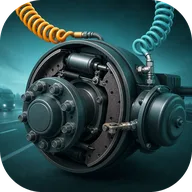
LGV study notes
Braking Systems
Air brakes, ABS, endurance brakes, brake fade, maintenance and freezing conditions.
What this topic covers
Air brakes, ABS, endurance brakes, brake fade, maintenance and freezing conditions. The full LGV & HGV Theory Test & Toolkit app contains 67 questions on this topic.
In the app's syllabus: Types of brake, Maintenance and inspection, Connection & proper use of the brakes, Tailgating, Freezing conditions, Anti-lock brakes.
Worked examples
Here are a few practice questions from this topic. Try answering each before reading the explanation.
When is trailer swing most likely to occur on a lorry and drawbar combination?
- A. While you're braking on a bend ✓ correct
- B. While you're using an endurance brake
- C. While you're steering at slow speed and fully loaded
- D. While you're moving off at an angle
You're driving a tractor unit fitted with 2 air lines. You want to couple to a trailer that has 3 air-line couplings. How should the air lines be connected?
- A. The trailer auxiliary line should be left unconnected ✓ correct
- B. The trailer service line should be left unconnected
- C. Only the service line should be connected
- D. Only the auxiliary line should be connected
What could prevent air pressure from building up in an air-brake system in frosty weather?
- A. Moisture in the air may form bubbles in the brake fluid
- B. The air will contract, reducing the pressure
- C. The dampness may cause valves to rust
- D. Moisture drawn in with the air may freeze and cause a blockage ✓ correct
You're driving a vehicle fitted with anti-lock brakes. What should you do when braking in an emergency?
- A. ‘Pump’ the brake pedal harshly
- B. Apply minimum force to the brake pedal
- C. Use the exhaust brake (retarder) before the footbrake
- D. Apply firm, continuous pressure to the brake pedal ✓ correct
More LGV study notes
Get all 67 questions on this topic in the LGV & HGV Theory Test & Toolkit app.